What Distinguishes Scientific Results From Non Science-based Claims
The claims it makes prohibit particular events or occurrences from happening. The key difference between genuine science and pseudoscience is that pseudoscience theories lack the substance of science but present themselves as scientific.
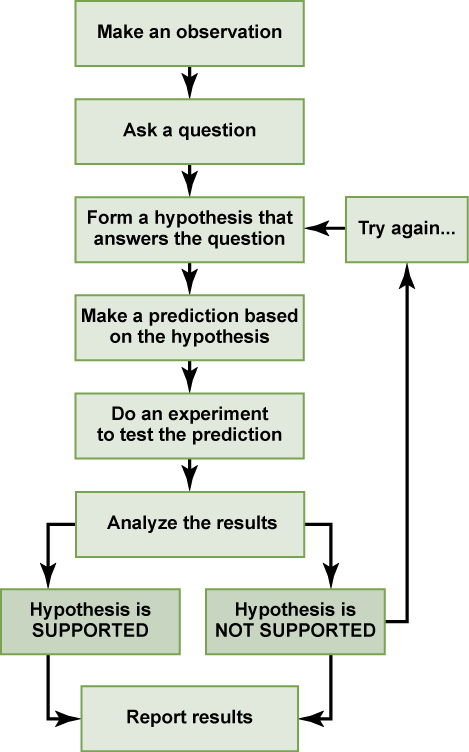
1 2 The Process Of Science Concepts Of Biology 1st Canadian Edition
Distinguishing Fake from Real News.
. An important component of being able to distinguish science from non-science is being able to determine the validity of information whether that be verbal eg TV YouTube podcasts or written published. While a pseudo-science is set up to look for evidence that supports its claims Popper says a science is set up to challenge its claims and look for evidence that might prove it. A scientific theory makes claims that are testable.
Challenge your peers to either agree or disagree with the scientific nature of your claim. I think you mean What is the key difference between a scientific and non-scientific theory Questions by their nature are neither scientific or otherwise except so far as they are asked in support of a theory. The process of science is designed to challenge ideas through research.
Science is a systematic and logical approach to discovering how things in the universe work. Construct a claim that you consider scientific and indicate how the claim meets the criteria for science that it is falsifiable and repeatable. Construct a claim that you consider scientific and indicate how the claim meets the criteria for science - that it is falsifiable and repeatable.
Despite all these philosophical investigations of science we havent yet had a focused discussion on what makes science what it is or what differentiates it from other human endeavours. That is science rests on certain axioms that non-science does not rest on. There are other theories as well.
Science is open to constant revision as new facts are discovered and integrated into the emerging picture of the world it seeks to formulate. Pseudoscience refers to claims that appear to be based on the scientific method but are not. Science is based on fact not opinion or preferences.
In a world where scientific theories often sound bizarre and counter to everyday intuition and where a wide variety of nonsense aspires to be recognized as scientific its important to be able to separate science from non-sciencewhat philosophers call the demarcation problem. Construct a claim that you consider scientific and indicate how the claim meets the criteria for science that it is falsifiable and repeatable. What distinguishes scientific results from nonscience-based claims.
Answer 1 of 3. Challenge your peers to either agree or disagree with the scientific nature of. Challenge your peers to either agree or disagree with the scientific nature of your claim.
Mechanisms such as peer review and repeatability of findings are used to try to ensure the validity of scientific advances. Previously published in December 2014. Science is a process of discovery and part of that process of discovery requires the recognition of patterns.
For those interested in this demarcation problem a good starting. Science begins with methodological rationalism whereas non-science is heavy with beliefs that may not even have an ethics of belief attached to them thus are not starting with methodological system of methods in thought actions or conclusions by means of a sold relation to valid and reliable reason andor evidence like science. Natural science is a branch of science concerned with the description understanding and prediction of natural phenomena based on empirical evidence from observation and experimentation.
Scientific tests are what. What distinguishes scientific results from nonscience-based claims. By contrast non-scientific theories tend to be more dogmatic.
My post about how to distinguish real science from fake science generated some interesting comments especially over my assertion that we have not as yet been able to come up with an unambiguous way to distinguish science from non-science and it prompted me to post a follow-up to try and clarify it. A rigorous science is able to make testable predictions. What makes one statement or claim science.
Does the treatment approach remain unchanged even in the face of contradictory evidence. One of the most beautiful examples of this is the periodic table of elements. The ten criteria for distinguishing between scientific and pseudoscientific treatment claims are.
Moreover to me axioms should in. Science is a process of discovery and part of that process of discovery requires the recognition of patterns. True to this definition science aims for measurable results through testing and analysis.
Inaccurate results can be decisively and quickly removed from the canon of scientific truth. Scientific results have undergone systematic and critical testing. 3 What distinguishes scientific results from nonscience-based claims.
Key definitions are Rationale. Along these lines how do you distinguish a scientific claim from a non-scientific claim or pseudoscience. Meanwhile Thomas Kuhn has advanced the notion that science is inherently a communal endeavor and that what distinguishes science from non-science is the way in which the scientific community functions.
Rather than modify an outdated premise when it finds new observations in a non-scientific theory the data may itself be ignored or denied. Find more answers Ask your question. And as for theories well technically hypotheses -.
Is the treatment unable to be tested or disproved. So far we have discussed scientific knowledge scientific methods scientific change and scientific progress. We have taken for granted that science is something different something unique.
Terms in this set 6 Difference between scientific method and other claims.

Scrutinizing Science Peer Review

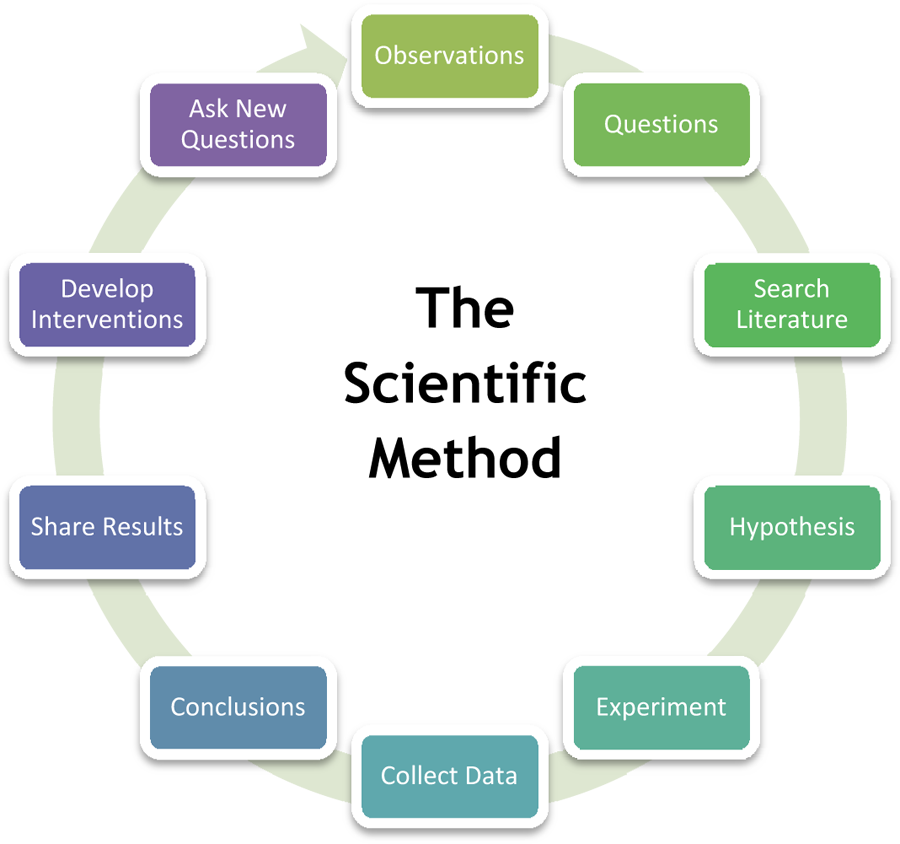
The Scientific Method Introduction To Chemistry
Module 1 Introduction What Is Research Ori The Office Of Research Integrity


Comments
Post a Comment